
Sayyal Health Services
Services & Innovations- ✨ INNOVATION HUB
Explore All Innovations Page
Hero banner, interactive filters & deep platform details.
Dedicated Platform PagesClick to view • ↗ Live site


Contact Person:Dr. Safwan Sayyal
Working Hours:Mon - Fri: 9:00 AM - 5:00 PM
Contact:info@sayyalhealth.com







Published: November 19th, 2026Last updated: November 19th, 2026
Injured at Work? A Workplace Injury Guide
Published on 19 Nov 2026Last updated on 19 Nov 2026
Workplace injuries can happen in almost any job, including construction, healthcare, warehouses, offices and delivery services. Some occur suddenly, such as falls, burns or equipment-related accidents. Others develop gradually through repetitive movements, physical strain or prolonged exposure to workplace hazards.
Either way, being injured at work can affect your health, income, daily activities and your ability to keep working.
What Is a Workplace Injury?
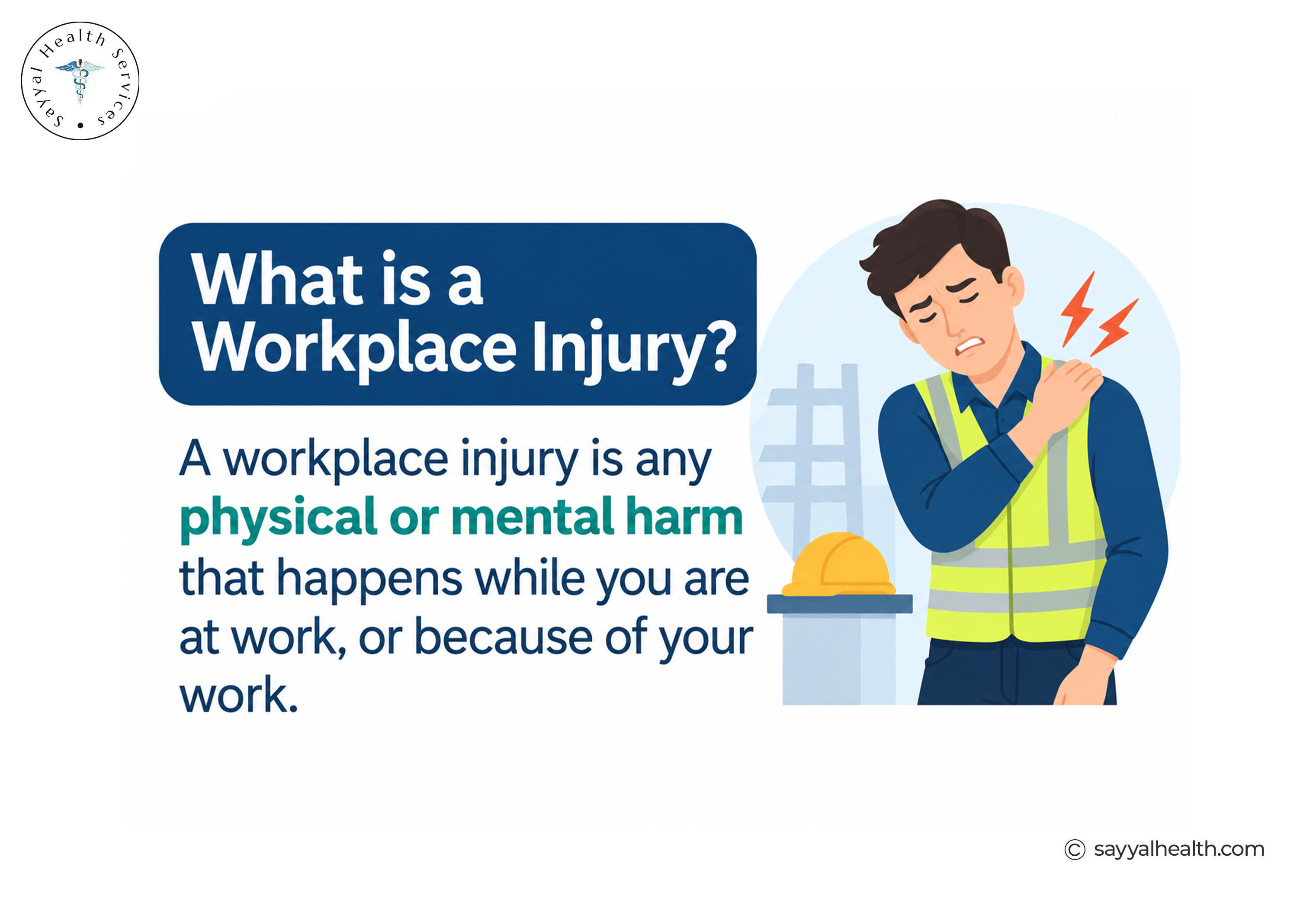
A workplace injury is an injury or illness that occurs because of, or is connected to, a person's work. It may result from a sudden accident, repeated activities or exposure to workplace hazards.
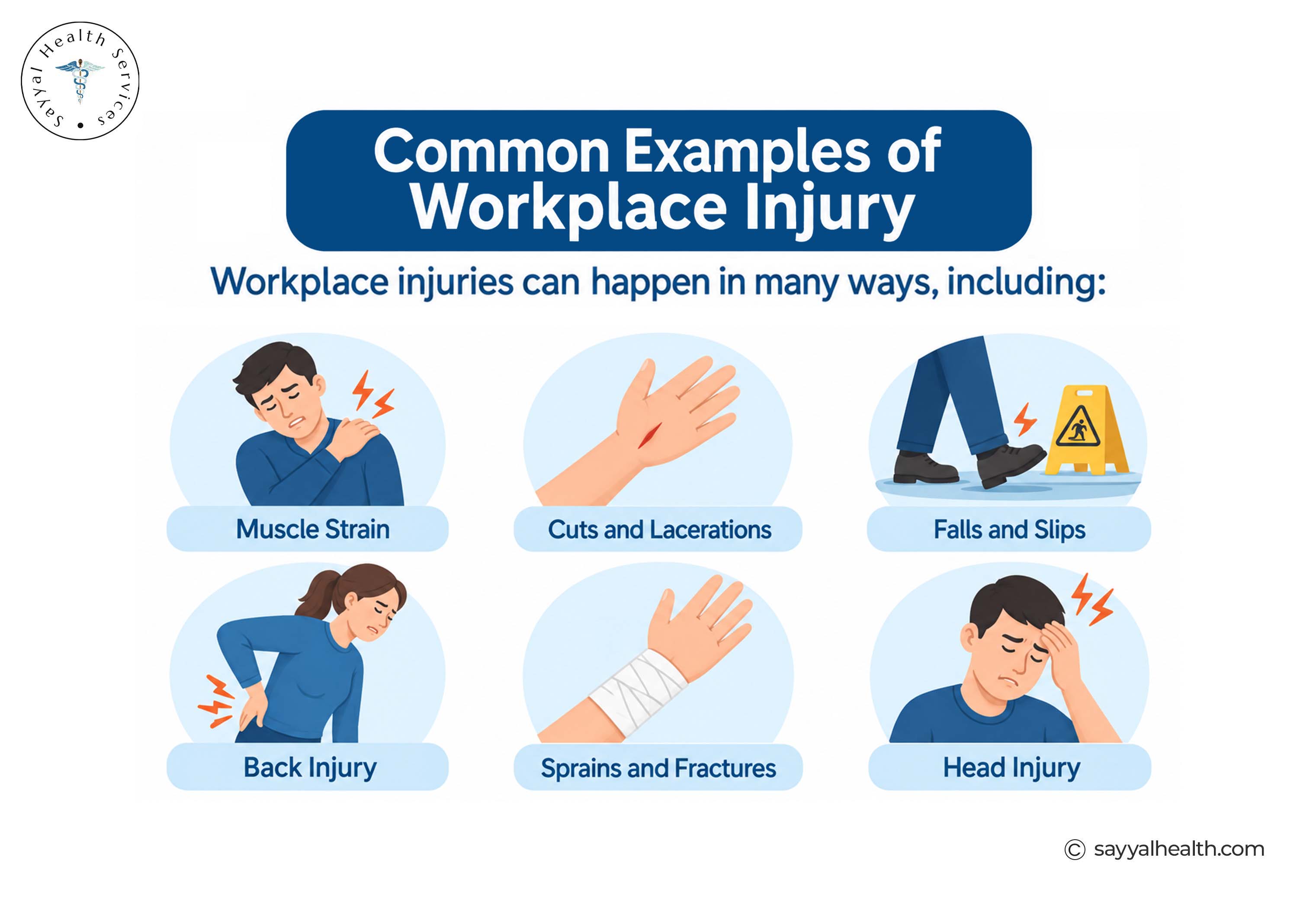
Here are the common examples of workplace injuries:
-
Injuries from workplace accidents, such as a fall from a ladder or a forklift collision.
-
Gradual-onset injuries that develop through repetitive work, such as wrist pain from constant keyboard or assembly-line tasks.
-
Musculoskeletal injuries: These affect muscles, bones, joints, tendons and ligaments. Examples include back pain, shoulder injuries and knee strains.
-
Other physical injuries: These include cuts, burns, fractures, sprains and injuries caused by workplace accidents.
-
Psychological injuries linked to work-related circumstances, such as exposure to trauma, bullying or violence.
-
Pre-existing conditions aggravated by work, such as an old back problem that worsens after heavy lifting duties.
Whether an injury is covered by workers' compensation depends on the legislation that applies to you and your individual circumstances, so an injury that did not happen in one moment can still be work-related.
Common Causes of Workplace Injuries
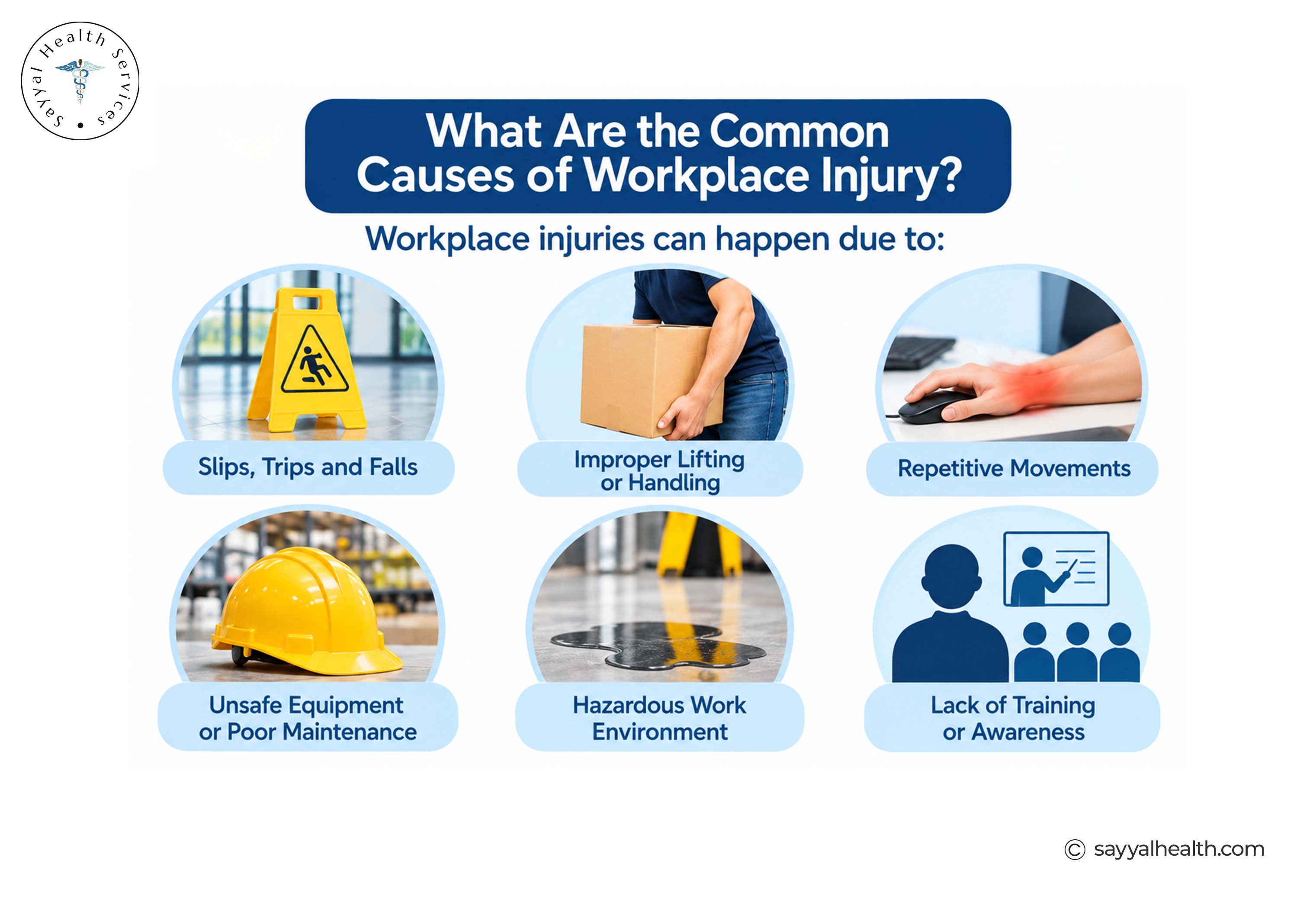
Most job-related injuries come from a handful of everyday situations. However, the common causes of workplace injuries are:
-
Slips, trips and falls. A wet floor in a kitchen or loose cables across a walkway.
-
Lifting or moving heavy objects. A warehouse worker lifting boxes without mechanical aids.
-
Repetitive movements and prolonged physical activity. A hairdresser repeatedly using their arms or a warehouse worker performing the same packing movements throughout a shift.
-
Poor ergonomics. A badly set-up desk or chair that gradually causes neck and back pain.
-
Contact with machinery or equipment. Unguarded moving parts or faulty tools.
-
Hazardous substances or unsafe environments. Chemicals, dust, noise or extreme heat.
-
Work-related psychological stressors: Workplace bullying, violence, traumatic events or other work-related circumstances that may affect a person's mental health.
What Is the Impact of a Workplace Injury?
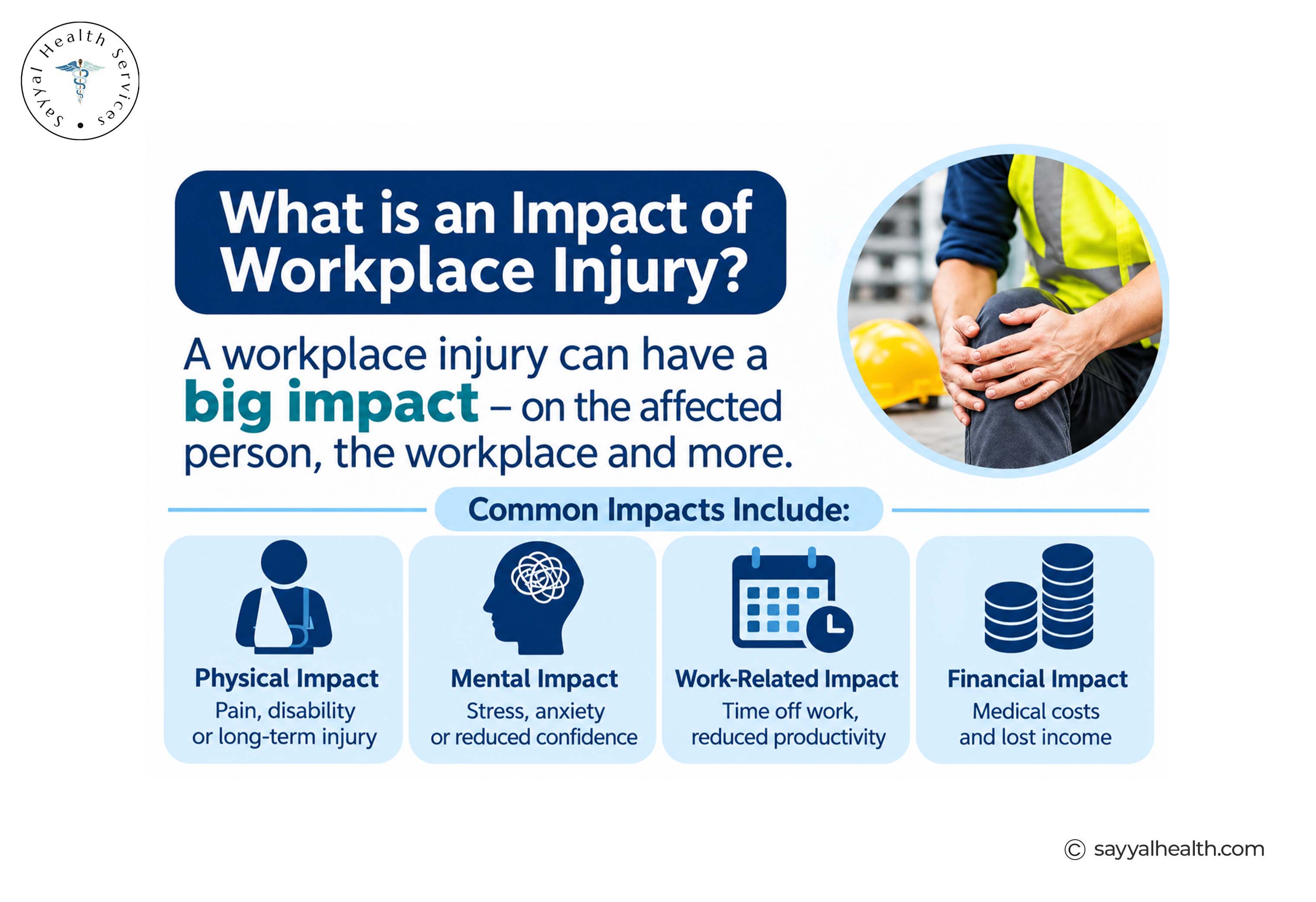
The impact of a workplace injury varies with the type and severity of the injury, but it often reaches beyond the injury itself:
-
Physical effects, including pain, reduced mobility and difficulty with everyday tasks.
-
Emotional effects, such as stress, anxiety or low mood while recovering.
-
Financial effects, including lost income, reduced hours and medical or rehabilitation costs.
-
Family and personal life, as caring, parenting and household responsibilities become harder.
-
Workplace effects, since employers and colleagues may need to adjust workloads and cover duties.
Understanding these effects is one reason early reporting and support matter.
What to Do If You Are Injured at Workplace
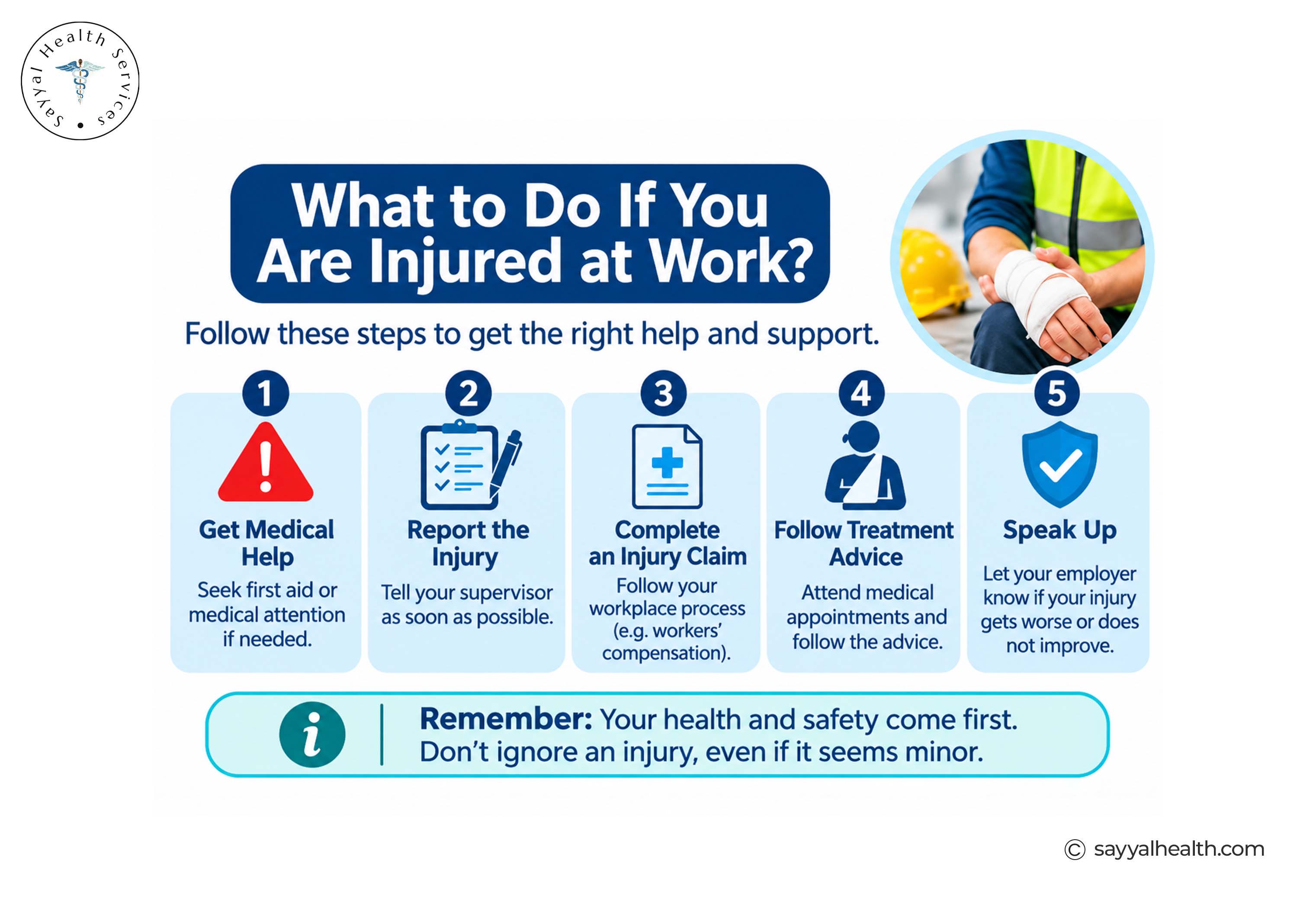
If you are unsure what to do if you are injured at work, these steps are a practical starting point. However, reporting requirements and deadlines differ between states, territories and schemes, so treat this as general guidance.
-
Seek medical attention. Get emergency care if needed, and see a doctor promptly for any injury, even if it seems minor. A medical assessment protects your health and creates a record.
-
Notify your employer. Tell your employer, supervisor or the relevant workplace contact as soon as reasonably possible.
-
Record the incident. Write down the date, time, location, what happened, who saw it and your symptoms.
-
Follow workplace reporting procedures. Complete the incident or injury report your workplace requires.
-
Keep your documents. Retain medical certificates, treatment records, receipts and relevant emails or letters.
-
Understand the claims process. Reporting an injury during work and lodging a workers' compensation claim are separate steps. Check what your scheme requires.
Your First Steps After a Workplace Injury
Follow this checklist during the first 24 hours after a workplace injury.
-
See a doctor and let them know the injury happened at work.
-
Tell your employer or supervisor, ideally in writing as well as verbally.
-
Write down what happened while it is fresh, including witness names.
-
Photograph the scene, equipment or visible injury if it is safe to do so.
-
Complete the required incident documentation and save a copy for your records.
-
Keep every medical certificate, receipt and piece of correspondence.
-
Find out which workers' compensation authority applies to you.
Not every injury follows an identical process, and claim deadlines are not the same everywhere, so check your own scheme's requirements promptly.
What Is Injury Management in the Workplace?
Injury management is a coordinated process that supports an injured worker's recovery, appropriate treatment, rehabilitation and safe return to work. It involves more than simply making a workers' compensation claim.
A claim deals mainly with entitlements and payments, while injury management focuses on your recovery and your working life.
Its main elements include:
-
Early reporting and identification of the injury.
-
Appropriate medical assessment and treatment.
-
Communication between you, your employer, your treating health professional and, where relevant, the insurer.
-
An injury management or return-to-work plan suited to your situation.
-
Monitoring your recovery and reviewing your work capacity.
-
Adjusting duties or hours when appropriate.
-
Supporting a safe and sustainable return to work.
Effective injury management considers your medical needs, work capacity, and individual circumstances rather than applying a one-size-fits-all approach.
Workplace Injury Management Services
Workplace injury management services may involve:
-
Injury management coordination.
-
Workplace rehabilitation support.
-
Return-to-work planning.
-
Functional and work-capacity assessments where appropriate.
-
Suitable duties and workplace adjustments.
-
Communication between the worker, employer, health professionals and insurer.
-
Support for people with physical or psychological injuries.
The services available depend on your circumstances, the workers' compensation scheme that applies and the providers involved. Not every injured worker automatically qualifies for every service.
Workers' Compensation and Injury at Work Claims in Australia
Workers’ compensation is a system funded mainly by employers to help workers who get injured or become ill because of their work.
In general, an injury at work claim involves reporting the injury, obtaining medical evidence, and lodging a claim through the process your scheme sets out. Employers and insurers then play defined roles in managing and deciding the claim.
Depending on your circumstances, workers' compensation may provide:
-
Payment of reasonable medical and rehabilitation expenses.
-
Weekly payments if you are eligible and cannot perform your usual duties.
Your work capacity and eligibility can affect what you receive, and the rules differ by state and territory, so check the requirements of your scheme.
Workers' compensation is also different from a common law or third-party damages claim. They are separate processes with separate requirements, and being eligible for one does not mean you are eligible for both.
Who is covered?
Schemes generally cover full-time, part-time and casual employees, and labour-hire workers may also be covered. Contractors are different: eligibility depends on the statutory definition of a worker in the relevant scheme and the details of the working arrangement.
WorkCover NSW and Workers' Compensation Across Australia
Australia does not have one national system. Each state and territory runs its own scheme under its own laws, with additional Commonwealth schemes for some workers.
NSW is a common source of confusion. WorkCover NSW was the name of the former agency, and the name still appears in everyday conversation and older documents. It is no longer the current claims administrator. Today, three separate bodies have distinct roles:
-
SIRA (State Insurance Regulatory Authority) is the independent regulator of the NSW workers' compensation scheme.
-
icare (Insurance and Care NSW) runs the scheme's insurance arrangements, and claims are managed through icare and its claims service providers.
-
SafeWork NSW is the workplace safety regulator that works to prevent injuries and make sure businesses follow safety laws.
NSW introduced significant workers' compensation reforms in 2026. New eligibility requirements and changes to certain entitlements apply to primary psychological injury claims first notified on or after 1 July 2026. The applicable rules depend on the type of injury and when it was notified. Workers should check SIRA's latest guidance for information about the current requirements.
|
States |
Main Official Source |
Role |
|
New South Wales |
SIRA, iCare, SafeWork NSW |
SIRA regulates the scheme, iCare manages insurance and claims, and SafeWork NSW regulates work health and safety |
|
Victoria |
WorkSafe Victoria |
Manages the scheme and regulates workplace safety, with claims handled through authorised agents |
|
Queensland |
WorkCover Queensland; Workers' Compensation Regulator |
WorkCover Queensland provides injury insurance, while the Regulator supervises the overall system. |
|
Western Australia |
WorkCover WA |
Regulates the scheme, with insurance provided by approved insurers |
|
South Australia |
ReturnToWork SA |
Administers the return-to-work scheme |
|
Tasmania |
Worksafe Tasmania |
Oversees workplace safety, licensing and workers' compensation. |
|
Australian Capital Territory |
WorkSafe ACT |
Regulator and main information source |
|
Northern Territory |
NT WorkSafe |
Regulator and main information source |
|
Common Wealth |
Comcare, Seacare, Department of Veterans’ Affairs |
Comcare covers certain Commonwealth employees, and the Seacare scheme covers certain seafarers |
Authority names and responsibilities can change, and not every worker fits neatly into these categories. Do not assume the same claim forms, medical certificates, reporting deadlines or benefits apply everywhere. Always confirm details on the relevant official website.
Workplace Rehabilitation and Returning to Work
Workplace rehabilitation helps an injured worker resume suitable work when it is medically appropriate. It may include:
-
A gradual return to work, building up hours and tasks over time.
-
Modified duties and reduced hours that match your current capacity.
-
Workplace adjustments, such as equipment changes or altered tasks.
-
Communication with your treating health professionals, so work arrangements reflect medical advice.
-
Monitoring and review, with plans adjusted as you recover.
-
Support if you cannot return to your previous role, including exploring suitable alternative duties.
Return to work should be guided by your health, your medical advice and your scheme's requirements. You should never feel pressured to return before you are ready.
What If Your Workplace Injury Claim Is Delayed or Disputed?
Claims are sometimes delayed or rejected. If that happens:
-
Ask for written information about the decision or the reason for the delay.
-
Make sure you understand why the claim was delayed or rejected.
-
Keep copies of all documents and communications.
-
Contact the relevant workers' compensation authority.
-
Consider independent legal or professional advice, such as a community legal centre, legal aid or a union if you are a member.
Review and dispute-resolution processes, and the time limits that apply, vary between jurisdictions, so act promptly.
Frequently Asked Questions
What should I do if I am injured at work in Australia?
Get medical attention, tell your employer as soon as reasonably possible, record what happened, complete the workplace report and keep your documents. Then check the claims process for your state, territory or scheme.
Can I make a workers' compensation claim if my injury develops over time?
Often yes. Injuries from repetitive work or ongoing strain may be eligible depending on the legislation and your circumstances, so report symptoms early and see a doctor.
What types of workplace injuries may be covered?
Workplace injuries that may be covered include physical injuries, musculoskeletal conditions, gradual-onset injuries, work-related illnesses and certain psychological injuries. Eligibility depends on the applicable workers' compensation legislation and individual circumstances.
Can casual employees claim workers' compensation?
Yes. Casual employees may be eligible for workers' compensation if they meet the requirements of the relevant scheme. However, employment status alone does not determine eligibility.
Are contractors eligible for workers' compensation?
It depends. Eligibility turns on the statutory definition of a worker and the nature of the working arrangement, so contractors should check with the relevant authority.
What is injury management in the workplace?
It is a coordinated process supporting treatment, recovery, rehabilitation and a safe return to work. It is broader than making a claim.
What are workplace rehabilitation services?
These are services that help an injured worker return to suitable work, such as return-to-work planning, workplace adjustments, work-capacity assessments and support with modified duties.
Can I resume work with adjusted duties after an injury?
Often yes, if your treating health professional considers it appropriate. Modified duties or reduced hours can support recovery, but your health and medical advice should guide the decision.
What steps should I follow to report a work injury in NSW?
Tell your employer, follow your workplace's reporting procedure and see a doctor. Claim steps are set by the NSW scheme, so check iCare and SIRA for the current process and forms.
What should I do if my workplace injury claim is rejected?
If your workers' compensation claim is not approved or takes longer than expected:
-
Request a written explanation from the insurer for the delay or outcome.
-
Check whether any additional information or documents are required.
-
Keep copies of medical records, claim documents and correspondence.
-
Contact the relevant workers' compensation authority to understand your review or dispute options.
-
Consider seeking independent legal advice or assistance from a community legal centre or union.
Conclusion
A work injury can affect your health, earnings and everyday activities. Reporting the injury promptly, seeking appropriate medical care, keeping accurate records and understanding the workers' compensation process can help you access the support available to you.
Injury management and workplace rehabilitation may also help you recover and return to suitable work when appropriate. Learn what support is available and ask a professional for guidance when necessary.
Know your rights, follow the reporting process that applies to you and ask for support when you need it. For advice about your own situation, contact your state or territory workers' compensation authority or a qualified professional.
Disclaimer:
This blog is for general informational purposes only and does not replace medical, legal or workers' compensation advice. Laws and eligibility vary across Australian jurisdictions. Some content and images may be AI-generated and may contain errors. Always verify important information with official sources and seek advice from qualified professionals.
References
1. Safe Work Australia. Workers’ Compensation.
2. Fair Work Ombudsman. Workers’ Compensation.
3. Healthdirect Australia. Workers’ Compensation.
4. Safe Work Australia. Workers’ Compensation Resources.
5. State Insurance Regulatory Authority (SIRA). What to Do After an Injury.
6. State Insurance Regulatory Authority (SIRA). Injured at Work: A Recovery at Work Guide for Workers.
7. Comcare. Make a Workers’ Compensation Claim.
Published on 19 Nov 2026Last updated on 19 Nov 2026
Was this article helpful?
Your feedback helps us create better content for everyone.