Contact Person:Dr. Safwan Sayyal
Working Hours:Mon - Fri: 9:00 AM - 5:00 PM
Contact:info@sayyalhealth.com








Published: April 22nd, 2026Last updated: September 23rd, 2026
GPs are the backbone of Australian healthcare. They are trusted by families, communities, and the entire health system. Learn everything from the first step of medical school to earning your FRACGP qualification. Whether you are an Australian student or an international medical graduate (IMG), this article will help you to understand how to become a GP and a full general practitioner guide in a simple way.
To become a general practitioner (GP) in Australia, you must complete a medical degree, gain general medical registration, complete internship and residency training, and undertake RACGP or ACRRM general practice training before obtaining fellowship certification. Here is the step-by-step guide.
Here is the complete process to become a GP in Australia.
Study MBBS or MD at an accredited Australian university (or overseas, for IMGs).
Work as an intern and then a resident at an Australian hospital. This usually takes two to three years in total.
Apply for full medical registration through AHPRA. This allows you to practise independently.
Apply to the Australian General Practice Training (AGPT) programme. This is the official government-funded pathway for GP training. This program places you in a real general practice clinic under supervision.
This image gives a simple overview, but training can vary depending on the college and your progress.
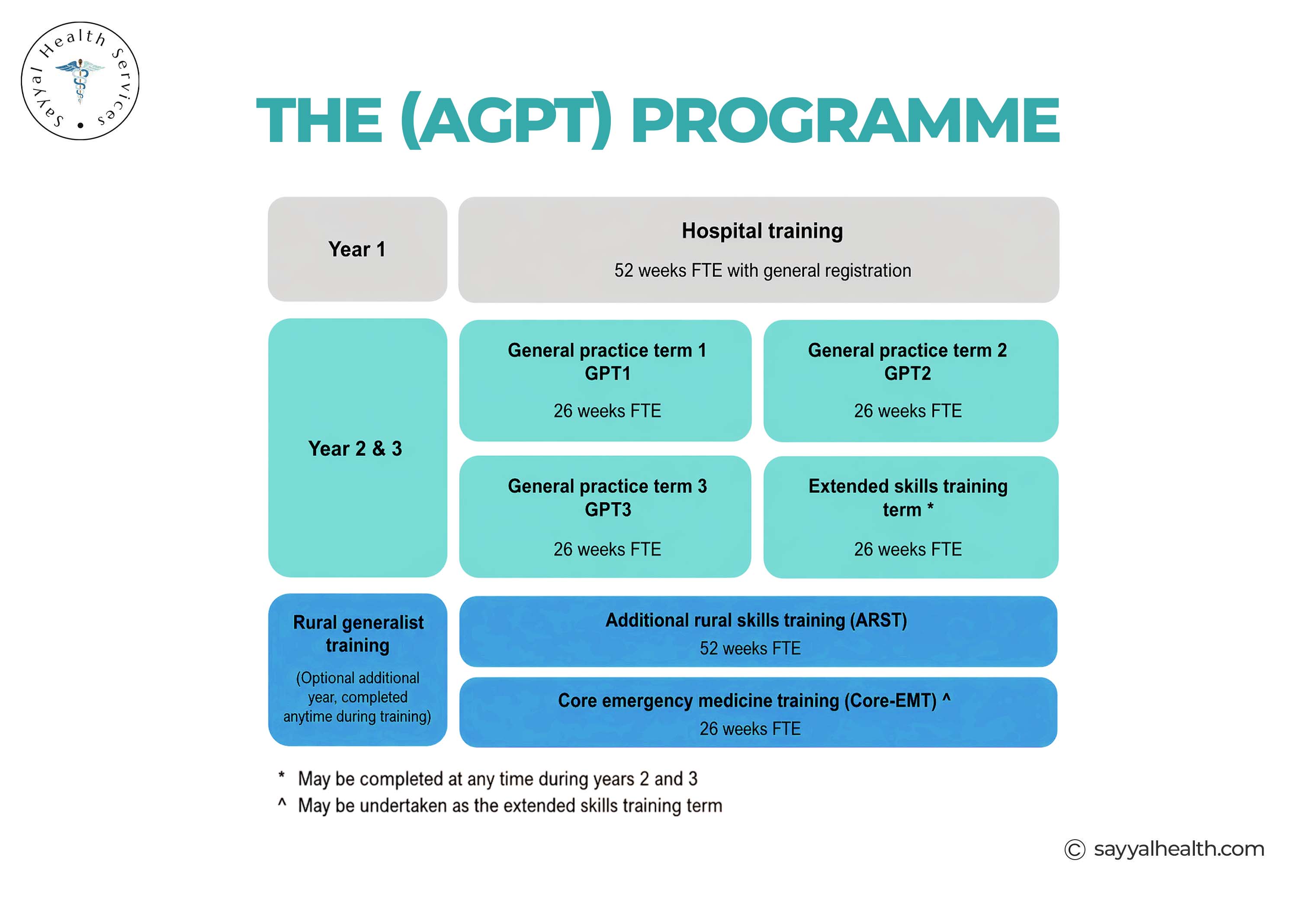
You must train through one of two recognised colleges:
Both lead to a full GP fellowship but differ in focus and assessment style.
After three years of supervised training (or more, depending on your pathway), you sit your fellowship exams and receive your FRACGP or FACRRM qualification.
It is a must to complete a medical degree and gain clinical experience to become a General Practitioner in Australia. Here is the academic foundation you need.
You need either:
Both degrees include theory and clinical placements at hospitals and clinics.
After earning a medical degree, it is important to complete a one-year internship at an accredited Australian hospital. During this year, you rotate through different departments, including emergency, surgery, internal medicine, and more.
After an internship, you become a resident medical officer (RMO). This stage lasts one to two years and allows you to build broader clinical skills before entering specialist training.
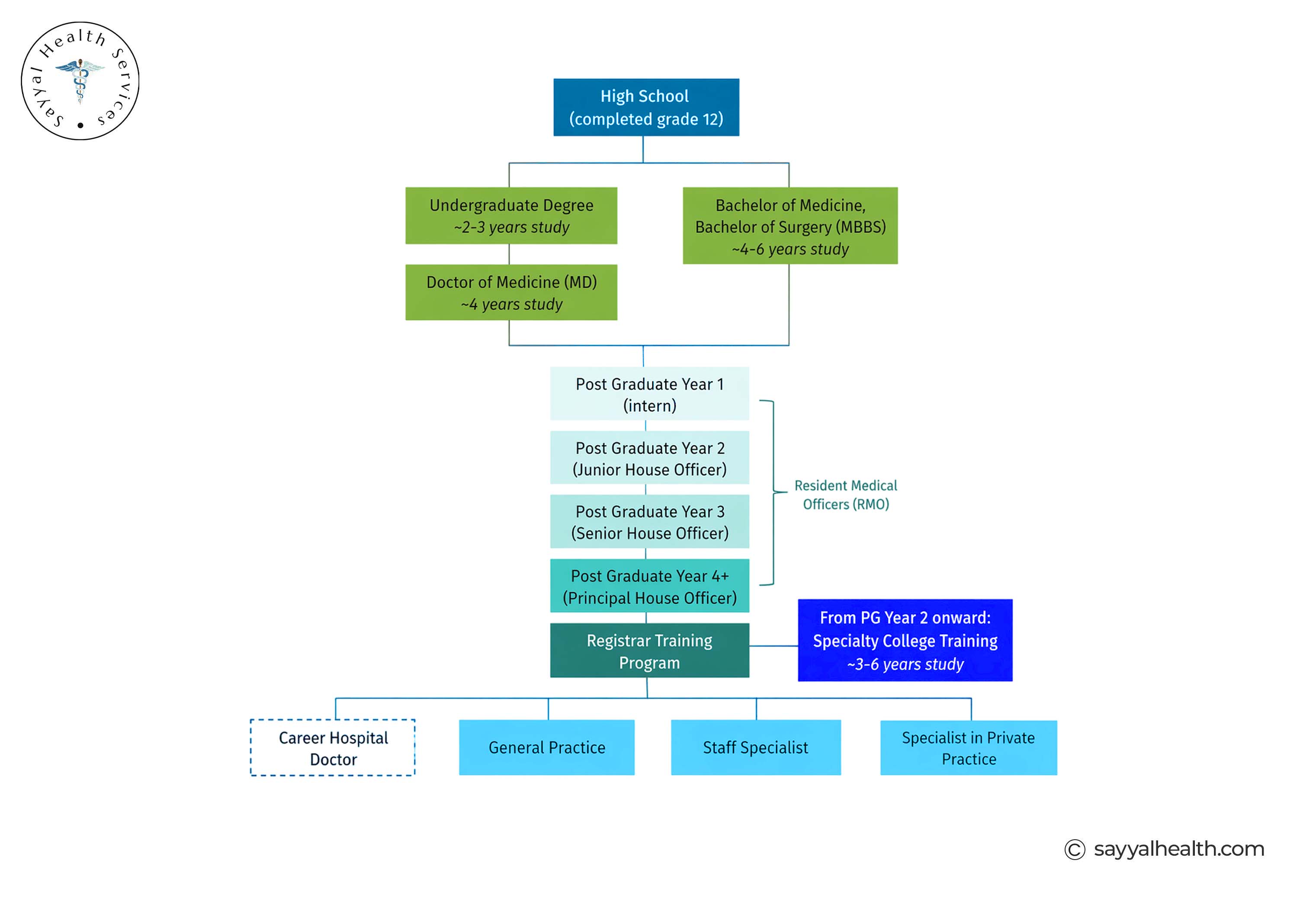
To legally practise as a doctor in Australia, you must meet these requirements:
AHPRA registration is mandatory. Without it, you cannot legally see patients in Australia.
The timeline is here:
|
Stage |
Duration |
|
Medical degree (MBBS/MD) |
4 to 6 years |
|
Internship |
1 year |
|
Residency |
1-2 years |
|
GP specialist training (AGPT) |
3 years |
|
Total |
Approximately 9 to 12 years |
So the honest answer to "how long does it take to become a general practitioner" is around 9 to 12 years from the start of medical school.
FRACGP means Fellow of the Royal Australian College of General Practitioners. It is the highest standard qualification for GPs in Australia. Once you earn your FRACGP, you are recognised as a fully qualified and independent GP.
This qualification proves that you have completed all required training, passed the necessary assessments, and are competent to provide high-quality general practice care in Australia.
During GP training, you will need to complete:
These assessments ensure that every GP meets a consistent and high standard of care.
A GP is the first doctor a patient sees. Here is what a GP does every day:
GPs are not just doctors. They are trusted health advisors for the whole family. That is why they are also called GP family doctors.
It takes more than medical knowledge to become a good GP. Here are the most important skills:
One major advantage of life as a GP in Australia is flexibility. Many GPs choose their own hours, work part-time, or even run their own clinics. This makes it one of the most family-friendly medical careers available.
In cities, GPs see a high volume of patients with a broad range of conditions. In rural areas, GPs take on more complex and diverse cases. That includes after-hours care, emergency response, and procedures that urban GPs would usually refer out.
Rural GPs are in very high demand. Because working in a rural area often comes with additional incentives, including financial bonuses and faster pathways to fellowship.
Like any medical career, being a GP has challenges. These challenges include:
But the rewards are significant. GPs form long-term bonds with their patients. They also watch families grow, that make a genuine difference in community health every single day.
GP income in Australia varies based on experience, location, and working arrangement. Here is a general overview that can vary and is not fixed.
|
Stage |
Estimated Annual Income |
|
GP Registrar (in training) |
AUD $80,000 to $120,000 |
|
Newly Qualified GP |
AUD $150,000 to $200,000 |
|
Experienced GP (5+ years) |
AUD $200,000 to $350,000+ |
|
GP Practice Owner |
AUD $300,000 to $500,000+ |
Rural GPs often earn more due to government incentives and higher billing rates. The general practitioner's salary in Australia is competitive compared to most other professions.
Factors that affect how much a GP earns include:
This is one of the most common questions asked by medical students. The honest answer is that it is challenging, but it is very achievable with the right mindset.
Here is what makes it demanding:
But it is also important to know that thousands of doctors successfully become GPs in Australia every year. It is because the training system is well-structured. In addition, support is widely available, and the career rewards are absolutely worth the effort.
If you trained overseas, you can still become a GP in Australia. The pathway is slightly different but very much achievable.
Submit your medical degree and experience for assessment through:
Most IMGs must pass the AMC Computer Adaptive Test (CAT) and the AMC Clinical Exam to prove their clinical competency.
Some IMGs with specialist-level qualifications from certain countries may qualify for a competent authority pathway, which can fast-track registration.
Once your qualifications are assessed and exams passed, you apply for AHPRA registration.
You then apply for the AGPT programme or an alternative supervised training arrangement, depending on your experience and assessment outcome.
IMGs often work in Distribution Priority Areas (DPAs), which are regions across Australia with a shortage of GPs. Working in these areas makes it easier to obtain the following:
Many IMGs find that working in regional or rural Australia is a strong starting point, as these areas are actively seeking qualified doctors.
Many people confuse these two roles of general practitioner and general physician. Here is a simple breakdown:
|
Feature |
General Practitioner (GP) |
General Physician |
|
Focus |
Primary and community care |
Internal medicine and complex adult disease |
|
Patients |
All ages, all conditions |
Mostly adults with complex conditions |
|
Setting |
Community clinics, private practices |
Hospitals |
|
Training pathway |
RACGP / ACRRM |
RACP (Royal Australasian College of Physicians) |
|
Referral role |
Refers to specialists |
Often, the specialist being referred to |
In short, a GP is your first point of contact, while a General Physician is a hospital-based specialist in adult internal medicine.
The RACGP is the largest organisation for rural and urban GPs in Australia. It sets training standards, administers the FRACGP fellowship, and supports GPs throughout their careers. Most GPs in metropolitan and suburban areas train under the RACGP training pathway.
ACRRM focuses specifically on rural and remote general practice. It offers the FACRRM fellowship and is the preferred pathway for doctors who want to serve regional and remote communities.
AHPRA is the national regulator for all health practitioners in Australia, including doctors. Every GP in Australia must be registered with AHPRA to practise legally.
Getting your qualifications is only half the journey when applying for GP roles in Australia. Your resume and cover letter decide whether you get shortlisted. Many strong doctors miss opportunities because their applications are not clear or well structured.
Your CV should be easy to read. Use a simple font and clear headings. Avoid colours, graphics, or fancy designs. Keep it one to two pages for early career doctors and up to three pages for experienced doctors.
Begin with a 3 to 5-line summary. Include your qualifications, AHPRA registration, experience level, and career goal. Keep it direct and specific.
Your CV should follow a clear structure:
Do not only list job titles. Add short bullet points under each role. Explain what you actually did. Mention patients seen, skills used, and responsibilities handled.
Use action words like managed, assessed, performed, or coordinated.
Give special attention to any GP rotations, community placements, or rural experience. Include relevant courses like chronic disease management or mental health training.
Your cover letter should be short. Use 3 to 4 small paragraphs. Avoid long explanations.
State the role you are applying for. Mention your AHPRA status and training stage. Keep it direct.
Highlight 1 or 2 key strengths. Focus on skills relevant to general practice. Do not repeat your CV.
Explain why you want to join this specific clinic. Mention their values, location, or training support. This shows genuine interest.
Thank the employer. Mention that your CV is attached. Say you are happy to attend an interview.
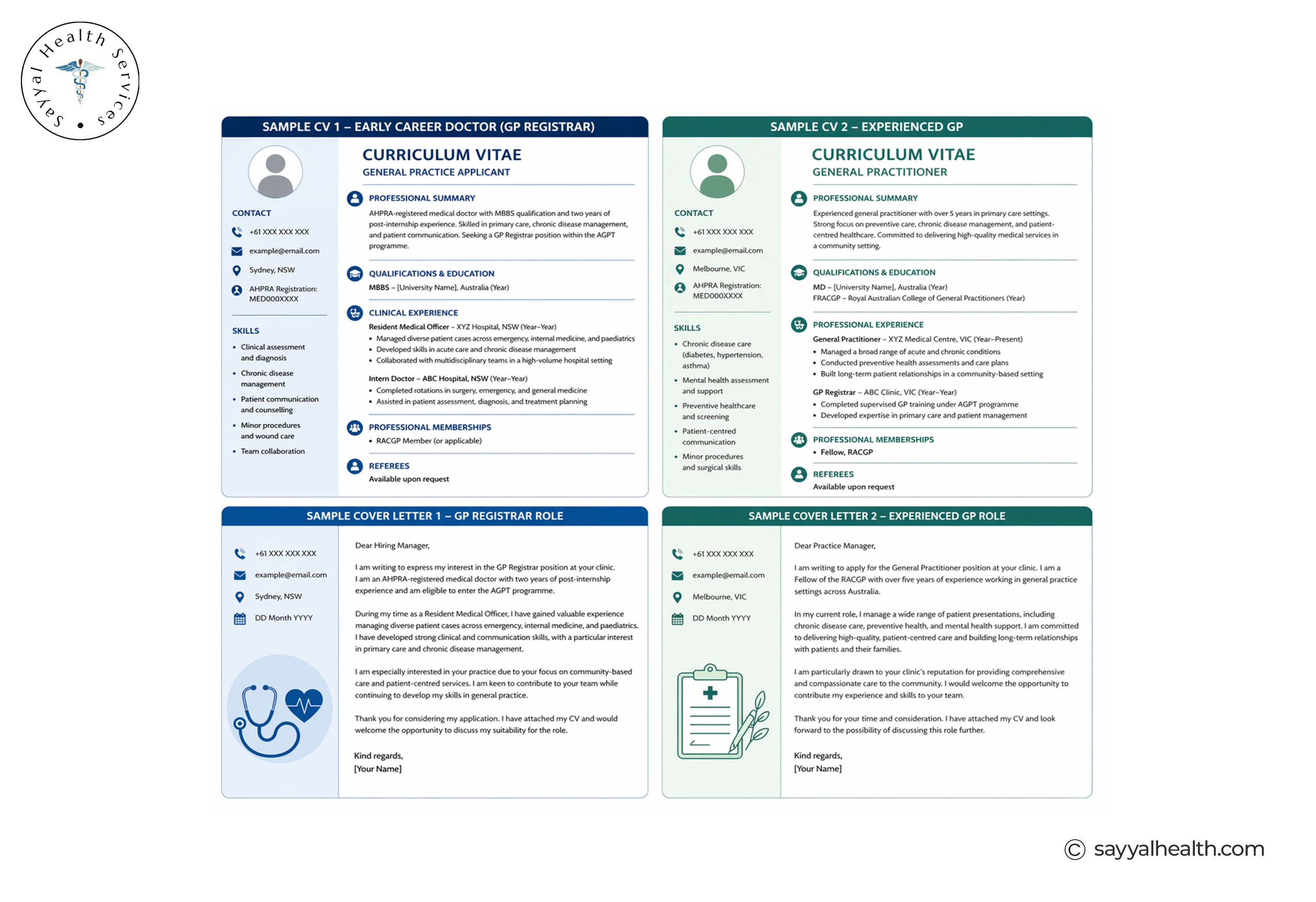
Update your CV regularly. Keep a record of your clinical work and training. Tailor every application to the role. Write in a simple and natural tone. Read your cover letter out loud before sending it. If it sounds too complex, simplify it.
A strong CV and cover letter will not guarantee a job. But a weak one can easily cost you an interview.
If you are looking for a walk-in general practitioner near me, most Australian clinics accept both booked appointments and same-day walk-ins for urgent matters. Many clinics now also offer online booking through platforms like HotDoc and HealthEngine.
If you are based in South-West Sydney and looking for a local general practitioner near Gregory Hills, Sayyal Health is a trusted community clinic in the area. The team at Sayyal Health provides comprehensive GP services.
Whether you need a routine check-up or ongoing care for a complex condition, a GP Gregory Hills clinic like Sayyal Health is equipped to support you and your family with personalised and compassionate care.
Q: How do I become a GP in Australia?
You must complete a medical degree (MBBS or MD) first. Finish your internship and residency, and register with AHPRA; then join the AGPT programme through RACGP or ACRRM. After three years of supervised training and passing your exams, you earn your FRACGP qualification.
Q: How long does it take to become a GP in Australia?
From the start of medical school to receiving your FRACGP, it typically takes between 9 and 12 years.
Q: What is a GP family doctor?
A GP family doctor is a primary care physician who manages the long-term health of individuals and families. They treat patients of all ages and coordinate care with specialists when needed.
Q: How can I find a walk-in general practitioner near me?
Search on Google, HotDoc, or HealthEngine for bulk-billing or private GP clinics near you. Many clinics in Australia accept walk-in patients for urgent care without a prior appointment.
Q: Is there a local general practitioner near Gregory Hills?
Yes. Sayyal Health offers GP services in and around Gregory Hills in South-West Sydney. You can book online or call the clinic directly for an appointment.
Q: How much does a GP earn in Australia?
A newly qualified GP earns approximately AUD $150,000 to $200,000 per year. Experienced GPs and practice owners can earn significantly more, especially in rural areas.
Q: Is it hard to become a GP in Australia?
It is challenging due to the length of training and competitive exams, but it is absolutely achievable. Thousands of doctors complete the pathway every year. With dedication and the right support, it is a very realistic goal.
Becoming a general practitioner in Australia is a long journey. But it is one of the most respected and flexible medical careers you can build. You get to be the doctor that patients trust most. You get to be there for people during some of the most important moments of their lives.
Whether you are just starting medical school, finishing your residency, or coming to Australia as an international medical graduate, the GP career pathway in australia is clear and well-supported.
Take it one step at a time and stay consistent, and you will get there.
This content is intended for general informational purposes only and should not be considered medical or professional advice.
Your feedback helps us create better content for everyone.